
- SOLUTIONS
- PRODUCTS
- SERVICES
- PARTNERS
- RESOURCES
What Is Quantum-Safe Networking? A Practical Guide for Enterprise Networks

Starview Technologies Appointed as an Authorized Distributor of Quantum XChange to Deliver Quantum-Safe Networking Solutions

Quantum-Safe Optical Networking: Combining PacketLight DWDM with Quantum XChange
What Is Quantum-Safe Networking? A Practical Guide for Enterprise Networks
As quantum computing advances, organizations are rethinking how they protect sensitive data and network communications. Discover what quantum-safe networking means, why it matters, and how enterprises can begin preparing without replacing their entire network infrastructure.
Quantum computing is creating a new challenge for organizations that rely on encryption to protect sensitive information.
While large-scale quantum attacks are not yet part of everyday cybersecurity, organizations are already considering the long-term impact of quantum computing on today’s cryptographic systems. For businesses managing sensitive data, critical infrastructure, financial information, healthcare records, intellectual property, or government information, preparing early can help reduce future migration risks.
This has led to growing interest in Post-Quantum Cryptography (PQC), cryptographic agility, and quantum-safe networking.
But what exactly is quantum-safe networking, and what does it mean for an enterprise’s existing network infrastructure?
What Is Quantum-Safe Networking?
Quantum-safe networking refers to network architectures and security technologies designed to help protect data and cryptographic operations against both today’s cybersecurity threats and future threats associated with quantum computing.
Importantly, becoming quantum-safe does not necessarily mean replacing an organization’s entire network.
Modern enterprise environments are typically made up of equipment from multiple vendors, including routers, switches, firewalls, encryptors, optical transport systems, cloud platforms, and security appliances.
A practical quantum-safe strategy therefore needs to work with existing infrastructure while providing a path toward stronger, more flexible cryptographic protection.
This is where Post-Quantum Cryptography (PQC), cryptographic agility, and modern cryptographic key management become important.
Why Do Organizations Need Quantum-Safe Networking?
1. Quantum Computing Changes the Cryptographic Risk
Many organizations have invested heavily in encryption to protect data in transit and communications.
However, the emergence of sufficiently capable quantum computers could eventually threaten some widely used public-key cryptographic algorithms.
There is also concern around the “harvest now, decrypt later” model, where encrypted information collected today could potentially be decrypted in the future as computing capabilities evolve.
For organizations responsible for long-lived sensitive data, quantum readiness is therefore becoming a long-term infrastructure consideration.
2. Enterprise Networks Are Multi-Vendor
A typical enterprise network may contain technologies from several different vendors.
Replacing these systems simply to introduce quantum-safe capabilities could be expensive, disruptive, and difficult to scale.
A more practical approach is to introduce quantum-safe security capabilities as an overlay layer that can work with supported existing network and security infrastructure.
Quantum XChange’s Phio TX® is designed around this approach, providing cryptographic management and key distribution while supporting interoperability with selected network and security platforms through industry-standard protocols.
3. Cryptography Needs to Evolve
Preparing for the quantum era is not simply about choosing one new algorithm.
Cryptographic standards and security requirements will continue to evolve. Organizations therefore need the ability to adapt their cryptographic controls without repeatedly redesigning their entire network.
This capability is known as cryptographic agility.
A crypto-agile architecture allows organizations to change or introduce cryptographic technologies as requirements evolve, helping reduce the disruption associated with future security migrations. Quantum XChange positions Phio TX around this crypto-agile model.
How Does Quantum-Safe Networking Work?
One practical way to understand quantum-safe networking is to think of it as an additional cryptographic management layer operating across the existing network.
Instead of replacing every router, firewall, or encryptor, a key-management platform can distribute cryptographic keys to supported network and security devices.
Enterprise Multi-Vendor Architecture
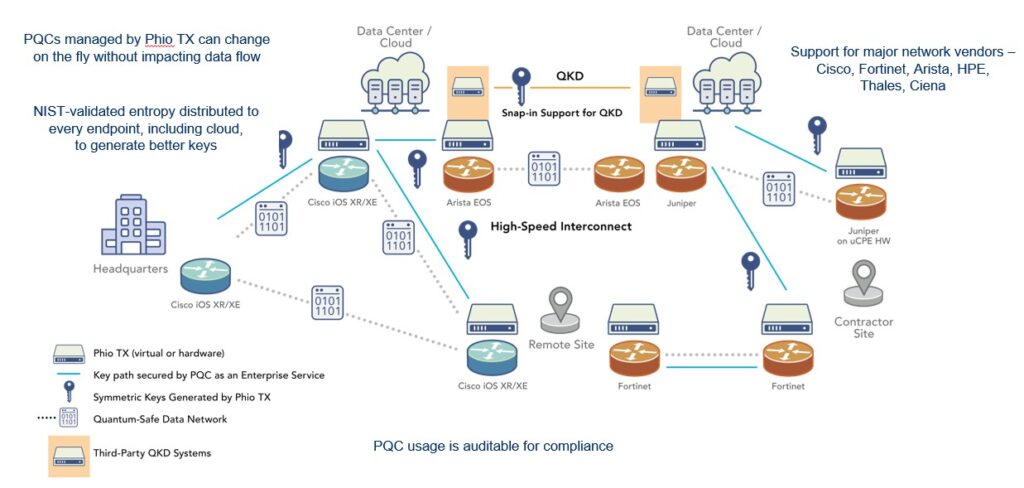
This architecture illustrates how a quantum-safe key-management layer can operate across a multi-vendor enterprise environment.
If QKD is desired, Quantum Xchange’s PhioTX can overcome the technology’s current distance and delivery limitations by distributing the keys generated by QKD using secure tunnel protected by PQC over TCP/IP network .The objective is not to create another isolated network. Instead, the cryptographic management layer works with supported infrastructure to help organizations introduce quantum-safe capabilities while continuing to leverage existing technology investments.
Phio TX is designed to support a range of network and security platforms and protocols, including environments using Cisco SKIP and ETSI GS 014
This approach can be particularly valuable for organizations operating complex, multi-vendor environments where a complete network replacement is neither practical nor necessary.
From Individual Connections to an Enterprise-Wide Architecture
Enterprise networks rarely consist of a single connection.
Organizations may operate:
- Headquarters
- Multiple data centres
- Disaster recovery sites
- Branch offices
- Cloud environments
- Remote facilities
- Regional networks
A quantum-safe strategy therefore needs to scale across multiple locations and network paths.
Phio TX Hive – Enabling Resiliency
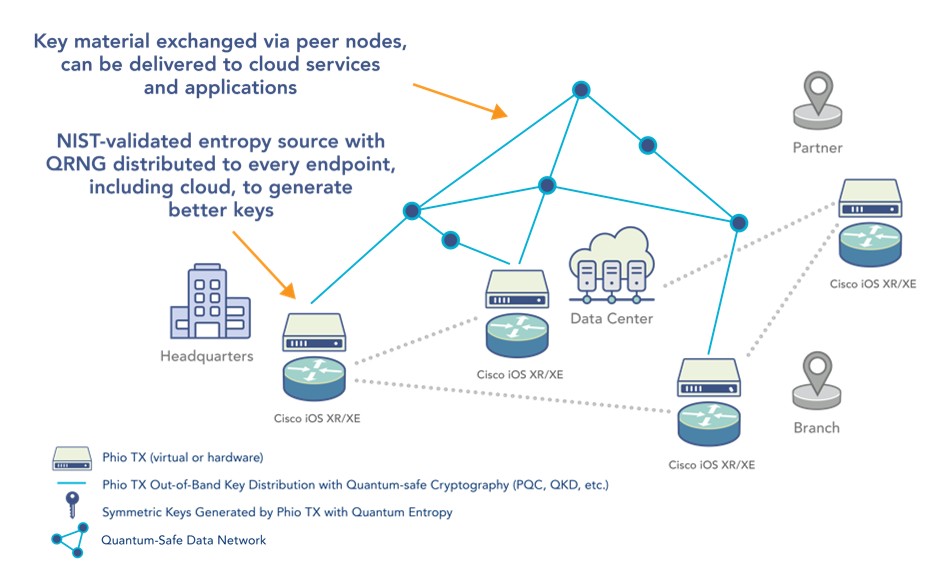
Phio TX uses a distributed Hive architecture to support key management across network environments.
The architecture is designed to provide distributed key routing and management, helping organizations extend cryptographic protection across multiple locations rather than relying on a single key-management point.
Quantum Xchange’s Hive architecture support fault-tolerant and load-balanced key transmission, as well as multiple key sources and cryptographic technologies.
For enterprises operating distributed data centres, branches, or cloud environments, this type of architecture can provide a scalable foundation for extending quantum-safe security across the organization.
Key Characteristics of Quantum-Safe Networking
A practical quantum-safe networking strategy should consider more than simply adopting a new encryption algorithm.
Multi-Vendor Integration
Support existing network and security infrastructure wherever possible, reducing the need for disruptive rip-and-replace projects.
Industry Standards
Standards-based approaches can help organizations integrate cryptographic key management with supported network and security platforms.
Cryptographic Agility
Security technologies and standards will continue to evolve. A crypto-agile architecture provides the flexibility to adapt as requirements change.
Secure Key Management
Quantum-safe networking requires a reliable approach to generating, distributing, managing, and rotating cryptographic keys.
Distributed Architecture
Large enterprises need security architectures that can extend across multiple locations, network paths, and infrastructure environments.
Flexible Deployment
Quantum XChange supports multiple deployment models for Phio TX, including physical appliances, virtual machines, containers, and cloud-based options, depending on the solution and environment.
Quantum-Safe Networking Is More Than Preparing for Quantum Computing
It is easy to think of quantum-safe networking as a technology that organizations only need to consider when quantum computers become powerful enough to threaten today’s encryption.
In reality, the preparation process can also encourage organizations to improve their current cryptographic management and security posture.
Organizations can begin by asking:
What encryption technologies are currently protecting our critical data?
↓
Where does sensitive data move across our network?
↓
How are cryptographic keys generated and distributed?
↓
Which network and security platforms need to be supported?
↓
How easily can our cryptographic infrastructure adapt to future standards?
These questions help turn quantum readiness from a distant theoretical concern into a practical infrastructure planning exercise.
How Can Organizations Begin Preparing?
Quantum-safe migration does not have to happen all at once.
A phased approach can help organizations understand their current environment and prioritize the areas where long-term protection is most important.
- Assess
Identify critical data, network connections, encryption technologies, cryptographic dependencies, and long-lived information that requires protection.
- Plan
Determine where Post-Quantum Cryptography, stronger key management, or other quantum-safe technologies can provide the greatest benefit.
- Integrate
Introduce quantum-safe capabilities into supported existing infrastructure without unnecessarily replacing working network equipment.
- Build Crypto-Agility
Prepare the environment to adapt as cryptographic standards, algorithms, and security requirements evolve.
- Scale
Extend the architecture across data centres, branches, cloud environments, and other critical infrastructure as requirements grow.
Where Does Optical Networking Fit?
Building a Quantum-Safe Network with Starview
Starview Technologies is an Authorized Distributor of Quantum XChange, providing access to quantum-safe cryptographic management solutions for organizations preparing for the post-quantum era.
Combined with Starview’s expertise in optical networking, DWDM, OTN, cloud infrastructure, and data centre solutions, Quantum XChange enables Starview to help organizations explore practical approaches to quantum-safe networking.
Whether the objective is to strengthen an existing network, prepare a new Data Center Interconnect, or develop a longer-term post-quantum security roadmap, the right architecture should be based on the organization’s existing infrastructure, security requirements, and future growth.
As organizations modernize their infrastructure, network capacity is increasing rapidly.
Data Center Interconnect, AI workloads, cloud services, and distributed computing are driving demand for higher-capacity DWDM and Optical Transport Networking (OTN) infrastructure.
But higher bandwidth also means more critical information is moving between locations.
This creates an important question:
How can organizations combine high-capacity optical connectivity with a security architecture designed for the post-quantum era?
This is where quantum-safe cryptographic management can complement high-capacity optical networking.
By combining Quantum XChange’s quantum-safe security technologies with PacketLight’s DWDM and OTN solutions, organizations can explore an integrated approach to building secure, resilient, and future-ready Data Center Interconnect environments.
Ready to Explore Quantum-Safe Networking?
Talk to Starview Technologies about your network, DCI, DWDM/OTN, and quantum-safe security requirements.