
- SOLUTIONS
- PRODUCTS
- SERVICES
- PARTNERS
- RESOURCES
Introduction to 800G Optical Module

The Next Generation: 800G and 1.6T Optical Transceivers

Why 1STACK Cloud is the Smarter Alternative to Buying Physical Servers
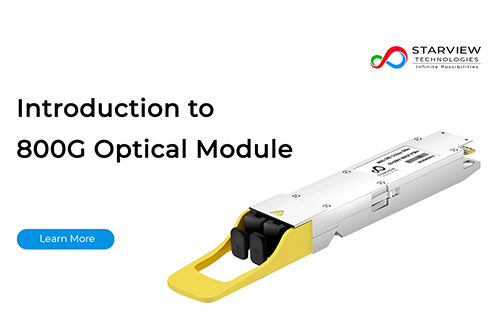
Introduction to 800G Optical Module
In an AI era marked by remarkable technological advancements, a groundbreaking innovation has emerged: 800G optical transceivers. This high-end equipment is set to revolutionize the way data is transmitted and received, heralding a new era in data communication.
What is 800G Optical Module?
An 800G module is a high-speed transmission module commonly used in data centres, communication networks, and other areas requiring high-density data transmission and high-speed data processing. It boasts the extraordinary ability to process 8 billion bits per second, more than doubling the capacity of its predecessor, the 400G optical module.
Requirements for the Development of 800G Module Technology
The development of 800G modules is closely tied to advancements in switch chip technology. The 800G chip market is gradually maturing, with companies like Marvell, Cisco, and Broadcom releasing 51.2T switch chips. All major network vendors are also gradually releasing their 51.2T switches. As a result, 800G optical modules are being deployed on a large scale, with industry standards being implemented and major vendors capable of mass production.
Standardization and Specification of 800G Modules
Several standards organizations are working on 800 Gbps standardization. The IEEE802.3 Working Group, OIF, and other organizations have established projects for 800Gb/s direct matching, testing, and coherent solutions. They are formulating related specifications and defining application scenarios and interface specifications for 800Gb/s optical modules. The 800G Pluggable MSA has released specifications for low-cost, short-distance transmission and longer-distance requirements. Additionally, the Optical Module MSA Working Group has formulated the first 800G QSFP-DD800 optical module standard.
- OIF Common Electrical I/O (CEI)-112G and Common Electrical I/O (CEI)-224G
- IEEE 802.3 Beyond 400 Gb/s Ethernet Study Group
- 800G Pluggable MSA (Multi-Source Agreement)
- OSFP MSA 200G/lane Electrical Signalling Group
Breakthroughs in Key 800G Technologies
The transition from 10G to 800G, from SFP to QSFP double density 800 MSA, is driven by three key technological advances:
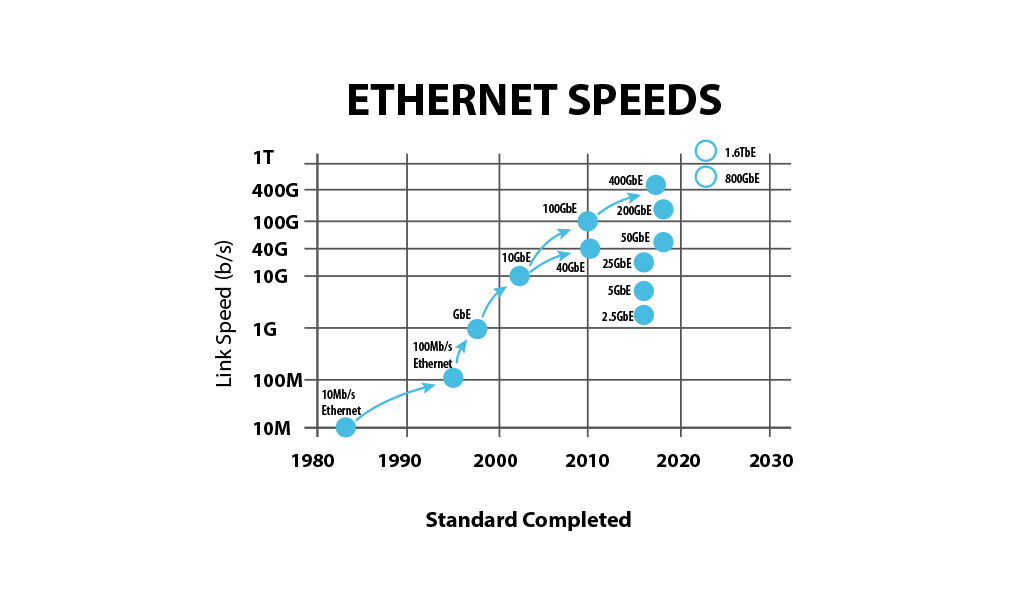
Increased Baud Rate
Enhancing the baud rate significantly improves each channel’s ability to transmit data, allowing for large data transfers and reduced latency.
Modulation Advancement
800G optical modules use PAM4 modulation, which supports higher data rates and improves network performance compared to traditional NRZ modulation.
Increased Channel Capacity
Higher data rates are achieved by using parallel channels or increasing the number of Fibers in the cable, further boosting the overall data transmission capability of the 800G optical module.
800G Module Packaging and Types
In the rapidly evolving world of data communication, 800G optical modules are at the forefront of innovation. Currently, there are two mainstream packaging types for these modules: QSFP-DD and OSFP. Let us explore each in detail.
QSFP-DD Packaging
QSFP-DD (Quad Small Form-Factor Pluggable Double Density) utilizes a dual-density, four-channel small hot-swappable optical module packaging. It adheres to IEEE802.3bs and QSFP-DD MSA standards. The electrical interface of this package features 8 channels, each capable of rates up to 25Gb/s (NRZ modulation) or 50Gb/s (PAM4 modulation), providing aggregated solutions of up to 200Gb/s or 400Gb/s. This makes it ideal for high-speed data transmission applications.
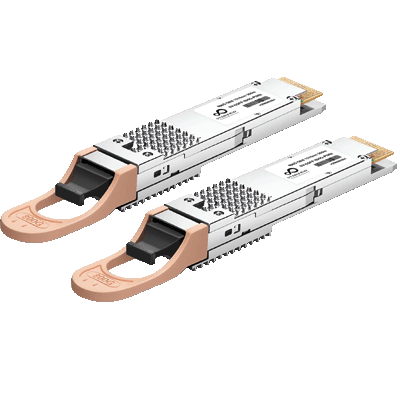
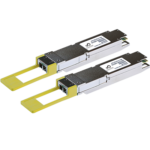
SV-QSFP-800G-PDR8 – Starview QSFP-DD 800G DR8 module distance up to 500m
Advantages of 800G QSFP-DD
Backward Compatibility
Compatible with QSFP+/QSFP28/QSFP56 packaging, ensuring seamless integration with existing infrastructure.Integrated Cage Connector
Utilizes a 2×1 stacked integrated cage connector, supporting both single-height and double-height systems.Thermal Capacity
The SMT connector and 1xN cage can achieve a thermal capacity of at least 12 watts per module, reducing heat dissipation requirements and associated costs.Flexible Design
The MSA working group designed QSFP-DD with user flexibility in mind, adopting ASIC design and supporting multiple interface rates, which reduces port and equipment deployment costs.
OSFP (Octal Small Form-Factor Pluggable) is a newer pluggable package, slightly larger than QSFP-DD. It features 8 high-speed electrical channels and supports 200G, 400G, and 800G rates. Common interfaces include LC and MPO, with variations in the OSFP package shell, such as versions with a heat sink and those with a flat top.
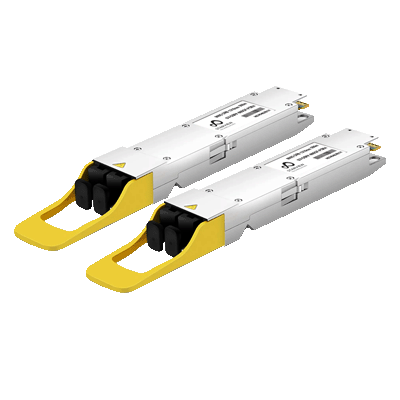
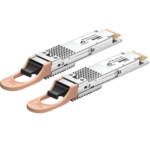
SV-OSFP-800G-PSR8 – Starview OSFP 800G DR8 module distance up to 50m
Advantages of 800G OSFP:
- Higher Bandwidth Density: Designed with 8 channels, directly supporting a total throughput of up to 800G.
- Enhanced Performance: Supports higher data transmission rates and longer transmission distances.
- Superior Heat Dissipation: Excellent heat dissipation design, capable of handling higher power consumption.
- Future-Proof Design: Larger size allows for higher power consumption, supporting future rates such as 1.6T or higher.
Comparison of QSFP-DD and OSFP
QSFP-DD is typically preferred in telecommunications applications, while OSFP is more suitable for data centre environments. Here are the main differences:
- Size: OSFP is slightly larger than QSFP-DD.
- Power Consumption: OSFP has slightly higher power consumption compared to QSFP-DD.
- Compatibility: QSFP-DD is perfectly compatible with QSFP28 and QSFP+, whereas OSFP is not.
Types of 800G Optical Modules
800G optical modules represent the next generation of high-speed data transmission technology, crucial for modern data centres and communication networks. These modules can be categorized based on their single-channel rates into two main types: single-channel 100G and single-channel 200G. Single-channel 100G modules are easier to implement, while 200G modules demand more advanced optical devices and require gearbox conversion due to the 112Gbps PAM4 electrical interface limit.
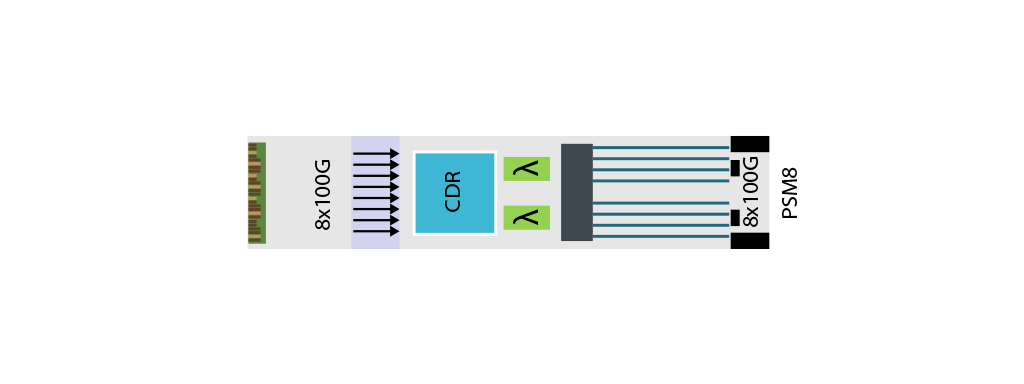
Multi-Mode 800G Optical Modules
For multi-mode applications, there are two primary standards for 800G optical modules, designed for transmission distances under 100 meters:
800G SR8
- Technology: Utilizes VCSEL (Vertical-Cavity Surface-Emitting Laser) technology.
- Wavelength: 850nm.
- Single-Channel Rate: 100Gbps PAM4.
- Optical Fibers: Requires 16 optical Fibers.
- Interface: MPO-16 or dual-row MPO-12 connectors.
- Description: This is an enhanced version of the 400G SR4, doubling the number of channels.
- Application scenario: The 800G SR8 module enabling high-speed 800G data interconnectivity within 100m inside of data centre, which facilitates rapid data transmission between servers and switches.
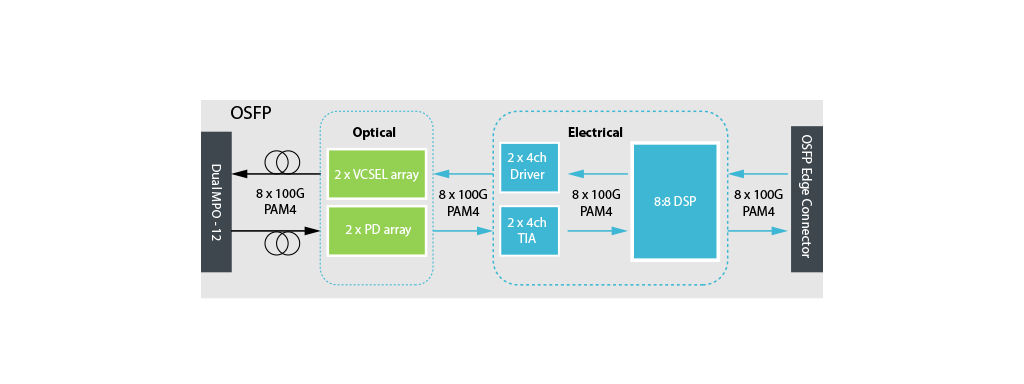
800G OSFP Block Diagram
How to Choose the Right 800G Optical Module for Your Network?
Selecting the appropriate 800G optical module for your network involves considering several key factors, including package type, distance, single mode or multimode fiber, power consumption. Here is a detailed guide to help you decide:
Package Type
There are two main package types for 800G optical modules: QSFP-DD and OSFP. Each has its own advantages and disadvantages, and compatibility with your network equipment is crucial.
- QSFP-DD: Compact and widely used in high-density data centres.
- OSFP: Slightly larger, offering better heat dissipation and potentially higher power consumption support.
Transmission Distance
Choose the appropriate transmission type based on your network requirements:
- Short Distance: Modules like SR8/PSM8 support up to 100m, DR8 and 2xDR4 support up to 500m, ideal for intra-data centre connections.
Multimode Fiber
- Multimode Fiber (MMF): Suitable for short distances, typically within data centres. Example include 800G SR8
Power Consumption
Power consumption is a critical factor, especially in large-scale data centres. High-power optical modules can significantly increase cooling costs and overall energy consumption. Therefore, opting for low-power optical modules is essential for reducing operating costs.
For instance, the 800G SR8 optical module has a maximum power consumption of under 13.5W, making it energy-efficient. It utilizes highly efficient VCSEL technology, which has low energy consumption, contributing to energy conservation and emission reduction in data centres. This module supports high-bandwidth applications in Ethernet, telecom, and InfiniBand networks, effectively balancing power efficiency with high performance.
Related Fiber Optic Transceivers
Related Articles
- Co-Packaged Optics (CPO): The Next Evolution of High-Speed Data Center Networking
- QSFP-DD vs QSFP56 vs QSFP28 Optical Transceivers
- 400G PAM4 Ethernet Transceivers – Introduction
- 400G QSFP-DD SR4.2 BiDi Optical Transceiver Module
- 400G DCO QSFP56-DD ZR and ZR+ Optical Module
- Extend your 100G reach to 100 km with our QSFP28 eZR4+ transceiver module
- Comprehensive Overview of 100G QSFP28 Transceiver Types
- Why QSFP28 ZR4 is The Best Choice for 100G long-haul Data Center Interconnect (DCI) transmission?
- Discover the benefits of 100G Bidirectional (BiDi) Optics for Data Centers
- Choosing Between 40G QSFP SR4 and BiDi: Your Comprehensive Guide
- Are you still searching for 40G QSFP+ BiDi module?
- Exploring the Differences Between SFP 10G SR, LR, ER, and ZR
- Multi-Rate Copper SFP+ Transceiver Module, designed to elevate your network capabilities like never before!